
Samuel Hvozdík on his Young Composer Award commission ‘Lichtmusik IV’
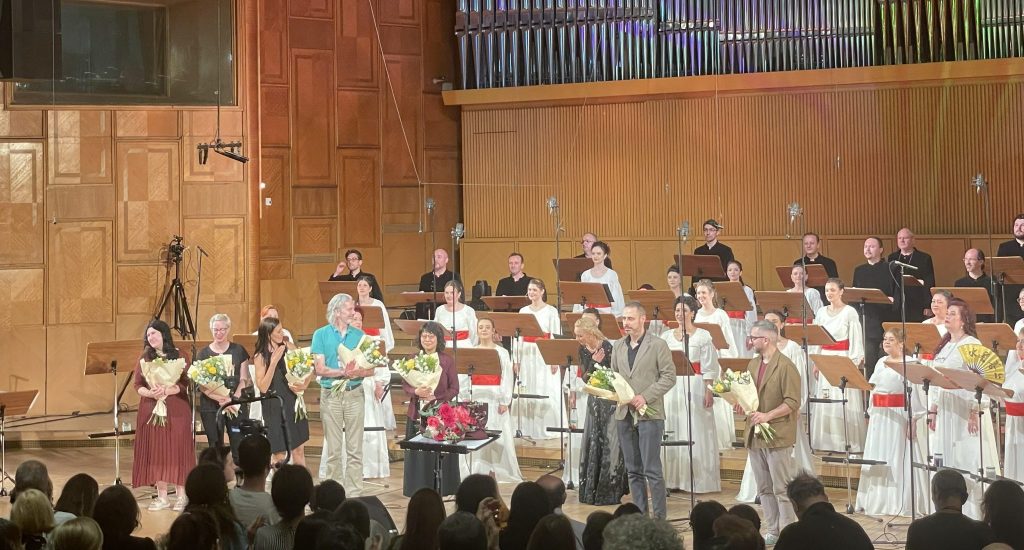
At every ISCM World New Music Days Festival, an international jury (constituted from the ISCM membership) presents an award to a composer under the age of 35 whose work is performed at the current festival. The winner gets a monetary prize and a commission for a new piece to be performed at a future edition of the ISCM World New Music Days. In 2024, at the World New Music Days Festival in the Faroe Islands, the ISCM Young Composer Award was awarded to Samuel Hvozdík (b. 1993 in Slovakia)for his organ composition Magma (2021), performed by Hans Hellsten in Fuglafjarðar Kirkja (video from 21:45). The ensuing commissioned composition, Lichtmusik IV for choir and electronics, received its première on 28 May 2026 during the World New Music Days Festival in Bucharest, Romania. Lichtmusik IV was performed by MADRIGAL – Marin Constantin National Chamber Choir (dir. Anna Ungureanu); the commission was supported by the Ernst von Siemens Music Foundation. I spoke with the composer the day after the concert.
What can you tell us about the concept of the new composition?
When I heard that there is a possibility to write for choir, it was really appealing for me. I didn’t write for choir for a long time, the last time was during my studies at the Academy of Performing Arts in Bratislava. It was actually a piece for choir and electronics, but it was for fixed media. In recent years I have become more and more interested to work with electronics. It interests me greatly and I like to explore it further, because I am self-taught in this field. So I asked if the new piece could be with live electronics and they said yes!
A general inspiration for the piece comes from Gustav Mahler. In one of his letters to his, to that day, closest confidant, Natalie Bauer-Lechner, he described the theme of the first movement of his Fourth Symphony and how it’s appearing during that movement. He described it as a drop of water on a leaf on a meadow that you would not notice when it’s in the shadow and light is not shining at this meadow; but when the sun shines, the whole meadow turns into a sea of light. I paraphrased this quotation and gave it more of the structure of a poem. When I began composing I started to put the text in the score, trying to really put it in a place, but after a few days or weeks of composing I realized that it wouldn’t work that way. The music I write is not corresponding with such a rich text. So I tried to focus more on the sound of the chords and the progression of the harmony. I just used some sounds and vowels, except for maybe two words I left in the score.

And then there is another idea which concerns the music itself. I am composing pieces in a series and there is an evolution in material throughout this series of pieces. I did one evolution thread from 2017 until about two years ago. After that I wanted to start new material thread and I started to write a cycle of pieces called Limerencia. I wanted to experiment with form: I was mostly writing my pieces in an arch shape form and I wanted to try something else, so, I started to put bricks behind one another. So in Lichtmusik I have four bricks and a coda with more rich electronics. The musical material I use in this thread is one chord, like a harmonic progression that is frozen at some point and you don’t know which way it should go. I froze the chord at a point where it can go different ways and only after a while a whole new context will start of this chord. The effect is that you don’t perceive it as one point in a progression, but as itself.
Connected with this is the idea of landscape music or drone music. I used to play that a lot, until it didn’t work for me anymore. So now I’m trying to use pauses to articulate the drones. For me, this opens a complete new level of perception of the sound in the silence. When you are actively listening to something and the sound stops, then you can feel an echo in the silence that follows. It is completely in your mind.
How did you experience the collaboration with the performers?
Working with choir it was quite easy. They are really great singers and a great ensemble. The conductor was really great and very professional. The electronics part was a bit more challenging because the only rehearsal we had was in a different place. So at the venue the sound was completely different. I didn’t have anything fixed, it was all live and there was an issue with feedback at the Radio Hall. But the technical team from the Radio was really helpful, so there wasn’t much we couldn’t solve.
What’s your experience of the festival?
This is my third time at an ISCM World New Music Days festival. The first time was in 2013, when it was in Košice, Bratislava and Vienna. I was studying at the conservatory then and I organized a concert with pieces of composition students, my fellow classmates. Then in 2024 I attended the festival in the Faroe Islands. For me the festival is mainly an opportunity to meet a whole bunch of different people, composers from all over the world, and here a wide variety of music.
What does the ISCM Young Composer Award mean to you?
It is a really great honor for me because in my life I hadn’t really won anything yet. So I am really happy with that, it means a lot to me. Even more so when I think of the fact that I’m the first Slovak composer to win that prize.

Rebecca Diependaele