
Artistic creation in times of war
| by Karmella Tsepkolenko, President of the ISCM Ukraine Section |
The war has changed the direction of the compositional strategies of many composers. For some, considering the various circumstances — the destruction of their homes, the presence of military operations in the areas where they lived, constant fear and threats to life — leaving the country became a reasonable and understandable choice. From abroad they observe the development of events, reflecting the war indirectly in their works or turning to other themes for artistic inspiration. For others, however, the natural choice was to remain in Ukraine and fight the enemy with their own weapon — artistic creation.
For such artists, the war has sharpened and focused the key directions of the development of national culture. These directions have become important reference points for the artistic community in its search for relevant forms of creative expression. One of the central tasks has been to preserve, through artistic works, the experience of those who are living through the current war of Russia against Ukraine. One of the first works to embody this artistic strategy was my composition Reading History (2022), a cantata for soprano (voice, percussion), cello, and piano (piano, voice) set to poetry by Oksana Zabuzhko.
In the first months of the war, I came to the conclusion that composers should also confront the enemy through their musical means. For this reason, I initiated the project Women Composers with Their Own Weapons, which became an artistic response to the war. Later, other composers joined this initiative. Four composers responded to this call: Alla Zahaikevych, Hanna Kopiyka, Asmati Chibalashvili, and Kyra Maidenberg-Todorova. The aim of the concert program was to create works that would serve as either a direct or an allegorical artistic response to the war.
The concert program included the following works:
Karmella Tsepkolenko: Reading History (2022) — cantata for soprano (soprano, snare drum), cello, and piano (piano, narration) to poetry by Oksana Zabuzhko
Hanna Kopiyka: Feelings (2022) — cantata for soprano, cello, and piano to poetry by Lina Kostenko
Asmati Chibalashvili: With Faith in Ukraine (2022) — for soprano, tempoblock, cello, piano, and video to poetry by Yuliia Dmytrenko-Despotashvili
Kyra Maidenberg-Todorova: My Beloved — for soprano, cello, and piano to poetry by Valeriia Zhigalina
Alla Zahaikevych: Songs of Presence (2022) — for soprano, cello, and piano to poetry by I. Kyva
The ensemble Senza Sforzando (Tetiana Mulyar soprano, Yevhen Dovbysh cello, Oleksandr Perepelytsia piano, artistic director), which became the first performer of these works, presented the program at several festivals in Ukraine and Germany. Through these performances, audiences had the opportunity to become acquainted with the works of Ukrainian composers created in response to the war.
The first performance took place in May 2022. A video recording was made in my private studio and posted on YouTube and social media. In a few days, the recording garnered over 1000 views and received many positive reviews from around the world. The piece was then performed many times both in Ukraine and abroad.[i] My next work on the theme of war was the cantata From where have you come flying black procession, fleeing swarm? (“Woher, schwarzer Tross, fliehender Schwarm, kommst du geflogen?“) a cantata for soprano, mezzo-soprano, tenor, and baritone based on the poetry of Serhiy Zhadan (commissioned by the association maezenatentum.at for the ensemble REIHE Zykan+, supported by BMKOES – special funding from Ukraine Aid).
In 2023, despite the war, we managed to resume holding the festival. The Twenty-Eighth International Festival of Modern Art Two Days and Two Nights of New Music took place on August 26 – 27, 2023, in Odesa Regional Philharmonic (full program). (Below is a recording of Day 1, including the program Women Composers with Their Own Weapons.)
Previous festivals have always started with words: “April has been chosen as the time for the “Two Days and Two Nights of New Music” festival because spring is a blossoming, a birth of new things, a time of outbreak of joy in nature and in human souls”. But the bloody, aggressive, full-scale war unleashed by Russia against Ukraine has forever changed the world we knew before. Instead of musical harmonies and chords, we heard the explosions of Russian missiles, and the Russian horde seized a part of our land, where they committed robbery, looting and plunder, tortured and killed Ukrainians. Large-scale destruction, environmental disasters, and the destruction of the Ukrainian people by racists have become our everyday life, and instead of creation and awakening, we have received destruction and death. The enemy is trying to destroy our people, infrastructure and the potential of Ukraine as a whole, launching devastating missile strikes on critical infrastructure, grain storage facilities, and shelling civilian objects and civilian homes. With extreme cynicism, the enemy is firing missiles to destroy Ukrainian culture – at cultural heritage sites under UNESCO protection. In Odesa, massive rocket attacks destroyed the city’s largest Orthodox church, the Transfiguration Cathedral, and damaged 28 architectural monuments, including the incredibly beautiful House of Scientists and the famous Stolyarsky Music Lyceum. Stolyarsky, which paves the way for Ukrainian talented children to enter the professional arts and has trained world stars, including violinists David Oistrakh and Nathan Milstein; pianists Emil Gilels, Yelizaveta Gilels, Yevhen Mohylevsky, and many others.
Is it appropriate to hold a festival during a time of war?
It is obvious that today one of the enemy’s goals is to destroy everything outstanding, everything that carries our national codes and culture – cultural institutions, projects and events, objects of cultural memory. Therefore, we must fight on the cultural front as well, and we must not lose our position as a European country that develops contemporary art. Therefore, we believe that our festival is appropriate now and is one of the stages of this struggle.
On August 24 and 25, 2024, the Twenty-Ninth International Festival of Contemporary Art Two Days and Two Nights of New Music took place. The festival is dedicated to the heroic struggle of the Ukrainian people against Russian invaders. The program combines works by Ukrainian and foreign composers written during the war, which to one degree or another reflect the indomitability of the Ukrainian people and their armed forces. The festival program included approximately 50 works, including 10 world premieres by Ukrainian and foreign composers (full program). Many musical performances were theatrical in nature, combined with artistic action, sound, video, film, and multimedia installations. Financial support came from the Ministry of Culture and Information Policy of Ukraine (Kyiv, Ukraine), Odesa City Council (Odesa, Ukraine). With financial support from the Ukrainian Cultural Foundation, an international scientific and creative conference was held entitled Festival and War: The Realities of Struggle and Resistance.
After more than three decades of painstaking work, the festival has become a true centre for the development of new music: more than 2,800 performances of approximately 2,600 works by Ukrainian and foreign composers (1,364 authors in total) have been staged. Thousands of artists and performers from different countries have taken part in the festival. Two Days and Two Nights has become a unique creative laboratory, where world and Ukrainian premieres are performed every year. In 2025 too, the audience heard bold and unpredictable contemporary music on the stage of the Odessa Philharmonic: from electroacoustics and multimedia projects to chamber works and interdisciplinary experiments. The festival was again dedicated to the heroic struggle of the Ukrainian people against Russian invaders and brings together works by Ukrainian and foreign composers written before and during the war. They reflect the resilience of the Ukrainian people and their armed forces. The music is an expression of human existence in all its depth, with all its suffering, despair, fear of death and destruction, yet it serves as a symbol of hope, resistance and faith in a swift and inevitable victory.
The program featured works by Valentin Silvestrov, Vasyl Barvinsky, Boris Lyatoshinsky, Karmella Tsepkolenko, Lesya Samodayeva, Volodymyr Runchak, Alla Zagaykevych, Viktor Kaminsky, Bohdan Segin and many others. Among the performers, the following stood out:
– the FENIX quartet and pianist Violina Petrychenko (Lviv), who performed music by Barvinsky and Lyatoshynsky;
– flutist Natalia Kozhushko-Maksymiv (Lviv), who captivated the audience with her virtuoso performance of contemporary Ukrainian works;
– the Senza Sforzando ensemble and symphony orchestra, which presented 18 compositions, most of which were world premieres, including works by Chinese composers He Zhigou, Li Yucin, and Donald Man-Ching Yu;
– Alla Zagaykevych (winner of the 2025 Shevchenko Prize), who, together with Georgiy Potopalskiy (electronics) and Yelizaveta Solovyova (bandura), created a new sound for the works of Valentina Silvestrova.
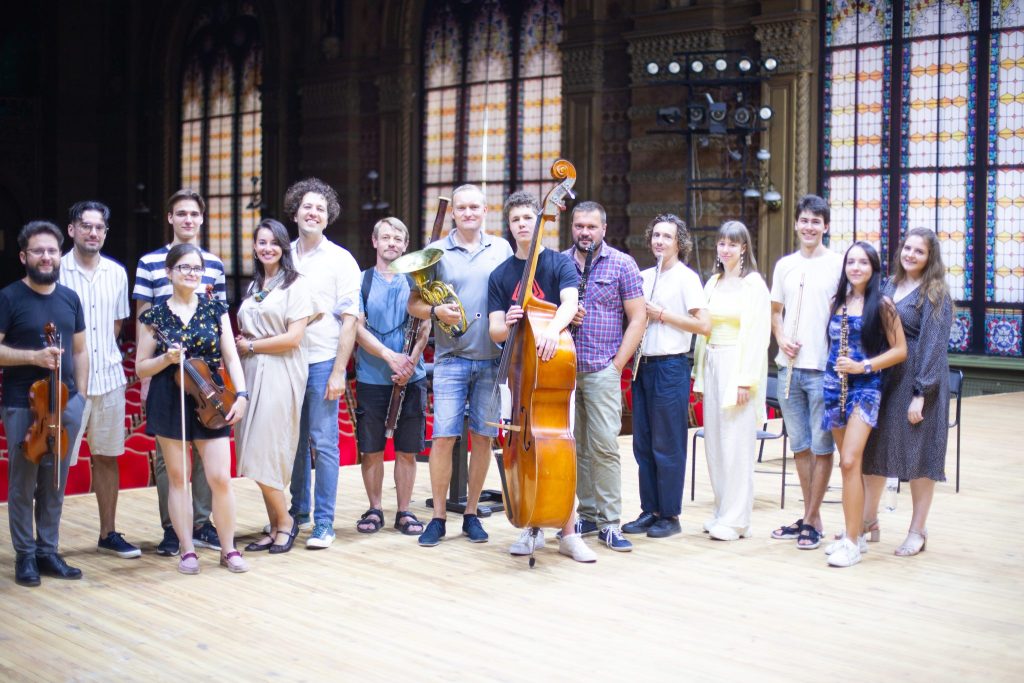
Ensemble Senza Sforzando
The festival was also graced with vivid interpretations of contemporary music by Serhiy Targoniy (accordion), Tetiana Sidletska (flute), Oleksandra Drobot (clarinet), the STRUM-SPECTRUM vocal ensemble, Mykola Kolodochka (piano, percussion) and other outstanding performers. The full program can be found here.
The festival Two Days and Two Nights of New Music confidently continues on its path, constantly opening new horizons for contemporary music from Ukraine and the world.
‘Art continues even when it seems that the world is shaking.’
In 2026, the festival will take on a special mission. The program will bring together works by Ukrainian and foreign composers created during the war, which directly or allegorically reflect the heroism of the Ukrainian people, the resistance of the Armed Forces of Ukraine, and the unprecedented support for Ukraine from the democratic world. Music will emerge as an artistic testimony of the times — a space of pain, fear, loss, and at the same time hope, resistance, and faith in inevitable victory. The structure of the 31st festival consists of three stages: Prelude concerts (21 August 2026); Main festival events (22–23 August 2026); Postlude concerts (24 August 2026). The festival will combine musical, visual, audiovisual, and scientific-educational formats. The project demonstrates the continuity of the cultural process, the resilience and indestructibility of Ukrainian culture as a form of resistance to aggression. The concept of the festival is dedicated to understanding war as an extreme existential experience of modern man and the heroic struggle of the Ukrainian people.
The festival will be interdisciplinary in nature and will include concerts, documentary film screenings, the exhibition project Art Through the Prism of War, and the international scientific conference Festival Under Fire: Chronicles of Resilience. The educational section will include masterclasses by prominent festival participants, who will give masterclasses in various specialties in order to support the professional level of students and young performers with the aim of overcoming the educational losses caused by the war. In terms of format, duration, direction and content, the festival Two Days and Two Nights of New Music is a unique event not only in Ukraine but also in the European cultural space. In the absence of a systematic presence of contemporary art in the media and repertoires of academic institutions, the festival remains virtually the only stable platform where chamber music, symphonic music and operatic works of new music are performed in interaction with theatre, painting, poetry and cinema. About 160 artists from Ukraine and abroad will take part in the festival events, and all events will be recorded in video and audio formats and made available via online broadcasts. The full program is available here.
[i] On September 26, 2022, the piece was performed at the XXXIII International Kyiv Music Fest (Small Hall of the National Music Academy of Ukraine)
On October 8, 2022, at the 28th Contemporary Music Festival “Contrasts”
On February 25, 2023 in Eckernferd (Germany) at the 9th International Festival of New Music in Eckernferd “ProvinceNoise 2023”
The work was also presented on June 13, 2022 in the Latvian radio program dedicated to Karmella Tsepkolenko (Vakara autorprogramma Ukrainu komponistes Karmellas Tsepkolenko kantate “Reading History” (“Lasot vesturi”), Anna Veismane)